
Our film and statistical study explores how Jaxson Dart’s mobility adds value to an inconsistent Giants rushing attack—and why Dallas must account for his legs on both designed runs and broken passing plays.
Jaxson Dart’s Legs Give the Giants a Threat Dallas Must Account For
Our film and statistical study explores how Jaxson Dart’s mobility adds value to an inconsistent Giants rushing attack—and why Dallas must account for his legs on both designed runs and broken passing plays.
Jaxson Dart’s Legs Give the Giants a Threat Dallas Must Account For
Our film and statistical study explores how Jaxson Dart’s mobility adds value to an inconsistent Giants rushing attack—and why Dallas must account for his legs on both designed runs and broken passing plays.
Jaxson Dart’s Legs Give the Giants a Threat Dallas Must Account For

7 Min Read
Kris Kretschman
Jaxson Dart’s Legs Give the Giants a Threat Dallas Must Account For
Jaxson Dart’s Legs Give the Giants a Threat Dallas Must Account For
Our film and statistical study explores how Jaxson Dart’s mobility adds value to an inconsistent Giants rushing attack—and why Dallas must account for his legs on both designed runs and broken passing plays.
Our film and statistical study explores how Jaxson Dart’s mobility adds value to an inconsistent Giants rushing attack—and why Dallas must account for his legs on both designed runs and broken passing plays.
Kris Kretschman
Kris Kretschman
August 24th, 2026
7 Min Read
6 min read
The first thing that stands out about Jaxson Dart in our Giants study is how much his mobility matters to the offense.
A defense can cover the initial routes and still give up a productive play when he finds an escape lane. We saw an example in our film review: Dart found room to scramble for nine yards. Those plays can turn a defense’s good work into a manageable next down for New York.
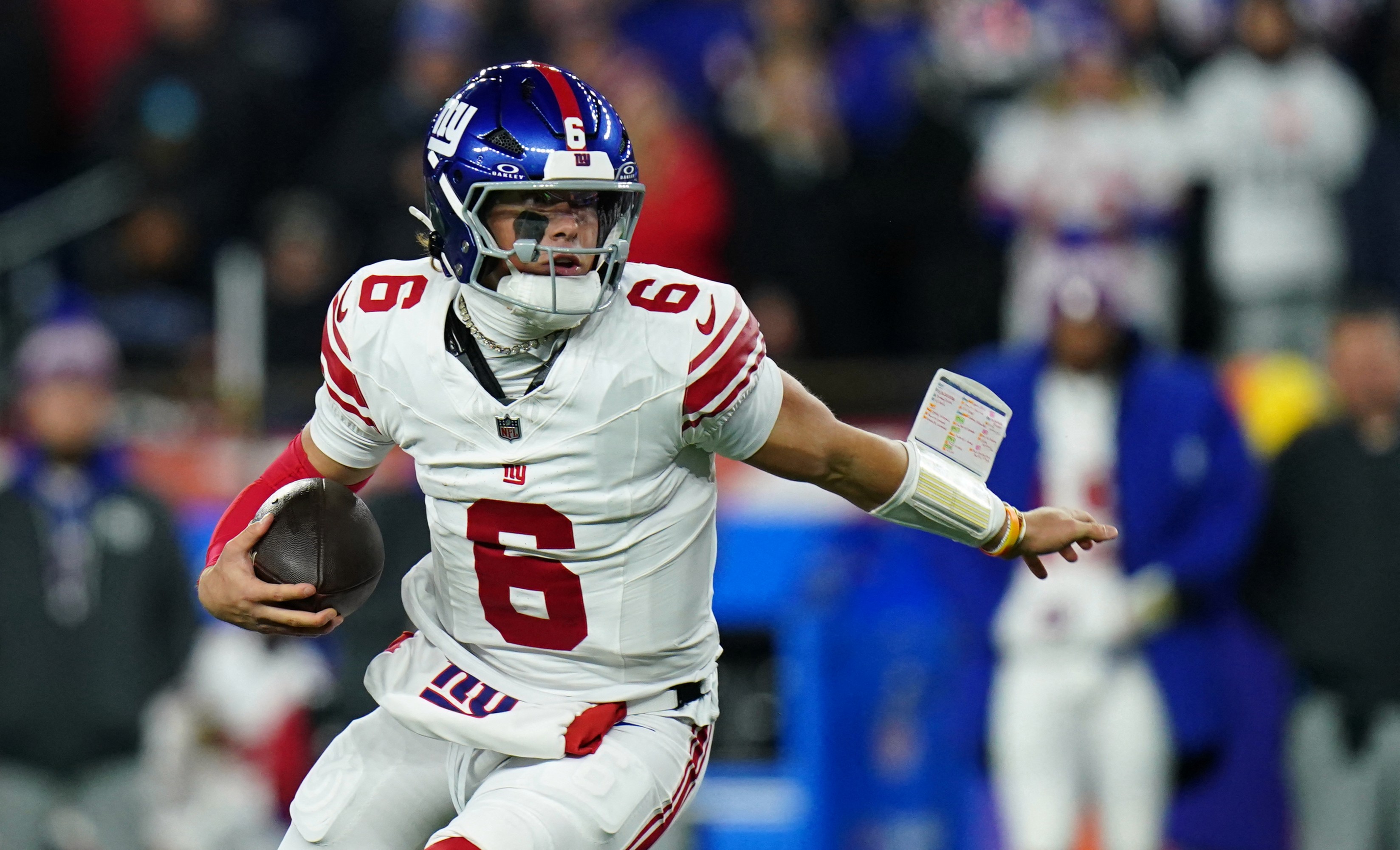
But his rushing threat extends beyond broken passing plays.
In our 2025 regular-season sample, with scrambles excluded, Dart recorded 48 carries for 197 yards, a 50% success rate and +0.093 expected points added per carry. EPA measures how a play changes an offense’s expected scoring outcome.
His 4.1 yards per carry might not jump off the page. The efficiency behind those yards deserves attention.
Dart Added Value in an Inconsistent Run Game
With Dart on the field, Tyrone Tracy recorded 110 carries for 480 yards, a 35.45% success rate and -0.055 EPA per carry. Cam Skattebo finished with 81 carries for 344 yards, a 44.44% success rate and -0.146 EPA per carry. Devin Singletary produced 309 yards on 76 carries, with a 39.47% success rate and +0.007 EPA per carry.
Dart’s non-scramble carries produced the highest success rate and EPA per carry of those four players.
That does not make quarterback runs and running back carries interchangeable. Their situations and assignments differ. It does show that Dart’s rushing provided value in an offense whose running backs often struggled to generate consistently positive results.

IMAGN IMAGES via Reuters Connect
The Quarterback Draw Deserves Attention
Among the individually charted quarterback concepts, the draw stood out.
Dart’s six draws averaged 8.5 yards per carry, produced +4.686 total EPA and had a 66.67% success rate. Two were classified as explosive runs.
Six attempts are a small sample, but they give Dallas something specific to prepare for.
A quarterback draw can punish a defense when its rushers get too far upfield and its underneath defenders expand into coverage. Dart’s mobility makes that space dangerous.
Our charting also showed productive quarterback power, counter and pull-lead plays, although each involved only two or three attempts. Those results establish possibilities Dallas should recognize; they are too limited to project as dependable averages.
Heavier Personnel Did Not Guarantee Better Rushing
The surrounding run game offers another useful clue.
On inside-zone handoffs from 11 personnel—one running back and one tight end—the Giants averaged 4.90 yards across 50 attempts, with a 52% success rate.
From 12 personnel—one running back and two tight ends—those figures fell to 3.34 yards and a 24.14% success rate across 29 attempts.
That is a substantial difference within this sample. It does not prove the extra tight end caused the decline, but it challenges the assumption that a heavier formation automatically made New York more effective on the ground.
Outside-zone handoffs also struggled overall: 65 attempts, 3.69 yards per carry and a 29.23% success rate.
Dallas should respect the Giants’ rushing options while making New York demonstrate it can sustain drives through its conventional ground game.
IMAGN IMAGES via Reuters Connect
The Challenge Is Finishing the Defensive Play
Our film notes also included an accurate, on-time outside throw to Lil’Jordan Humphrey and a quick completion to Theo Johnson with pressure arriving. Those individual plays showed Dart executing within the passing game, though they are not enough to establish his overall passing efficiency.
For Dallas, the takeaway is maintaining discipline through the entire down.
Pressure must arrive with controlled rush lanes. Coverage defenders need clear responsibilities when Dart leaves the pocket. Designed quarterback runs require their own answers.
The Giants’ rushing numbers reveal an offense with inconsistent production around its quarterback—and a quarterback capable of adding value with his legs.
Dallas has to make the first defensive win count. Forcing Dart off his initial answer accomplishes little if the next thing he sees is open grass.
Editorial note: This article was written with AI assistance using statistical research and film-study notes provided by Kris Kretschman.
The first thing that stands out about Jaxson Dart in our Giants study is how much his mobility matters to the offense.
A defense can cover the initial routes and still give up a productive play when he finds an escape lane. We saw an example in our film review: Dart found room to scramble for nine yards. Those plays can turn a defense’s good work into a manageable next down for New York.
But his rushing threat extends beyond broken passing plays.
In our 2025 regular-season sample, with scrambles excluded, Dart recorded 48 carries for 197 yards, a 50% success rate and +0.093 expected points added per carry. EPA measures how a play changes an offense’s expected scoring outcome.
His 4.1 yards per carry might not jump off the page. The efficiency behind those yards deserves attention.
Dart Added Value in an Inconsistent Run Game
With Dart on the field, Tyrone Tracy recorded 110 carries for 480 yards, a 35.45% success rate and -0.055 EPA per carry. Cam Skattebo finished with 81 carries for 344 yards, a 44.44% success rate and -0.146 EPA per carry. Devin Singletary produced 309 yards on 76 carries, with a 39.47% success rate and +0.007 EPA per carry.
Dart’s non-scramble carries produced the highest success rate and EPA per carry of those four players.
That does not make quarterback runs and running back carries interchangeable. Their situations and assignments differ. It does show that Dart’s rushing provided value in an offense whose running backs often struggled to generate consistently positive results.
IMAGN IMAGES via Reuters Connect
The Quarterback Draw Deserves Attention
Among the individually charted quarterback concepts, the draw stood out.
Dart’s six draws averaged 8.5 yards per carry, produced +4.686 total EPA and had a 66.67% success rate. Two were classified as explosive runs.
Six attempts are a small sample, but they give Dallas something specific to prepare for.
A quarterback draw can punish a defense when its rushers get too far upfield and its underneath defenders expand into coverage. Dart’s mobility makes that space dangerous.
Our charting also showed productive quarterback power, counter and pull-lead plays, although each involved only two or three attempts. Those results establish possibilities Dallas should recognize; they are too limited to project as dependable averages.
Heavier Personnel Did Not Guarantee Better Rushing
The surrounding run game offers another useful clue.
On inside-zone handoffs from 11 personnel—one running back and one tight end—the Giants averaged 4.90 yards across 50 attempts, with a 52% success rate.
From 12 personnel—one running back and two tight ends—those figures fell to 3.34 yards and a 24.14% success rate across 29 attempts.
That is a substantial difference within this sample. It does not prove the extra tight end caused the decline, but it challenges the assumption that a heavier formation automatically made New York more effective on the ground.
Outside-zone handoffs also struggled overall: 65 attempts, 3.69 yards per carry and a 29.23% success rate.
Dallas should respect the Giants’ rushing options while making New York demonstrate it can sustain drives through its conventional ground game.
IMAGN IMAGES via Reuters Connect
The Challenge Is Finishing the Defensive Play
Our film notes also included an accurate, on-time outside throw to Lil’Jordan Humphrey and a quick completion to Theo Johnson with pressure arriving. Those individual plays showed Dart executing within the passing game, though they are not enough to establish his overall passing efficiency.
For Dallas, the takeaway is maintaining discipline through the entire down.
Pressure must arrive with controlled rush lanes. Coverage defenders need clear responsibilities when Dart leaves the pocket. Designed quarterback runs require their own answers.
The Giants’ rushing numbers reveal an offense with inconsistent production around its quarterback—and a quarterback capable of adding value with his legs.
Dallas has to make the first defensive win count. Forcing Dart off his initial answer accomplishes little if the next thing he sees is open grass.
Editorial note: This article was written with AI assistance using statistical research and film-study notes provided by Kris Kretschman.
Kris Kretschman Newsletter
Kris Kretschman Newsletter
Get Cowboys columns, film notes, and show updates straight to your inbox.
Get Cowboys columns, film notes, and show updates straight to your inbox.
You’re on the list after submitting a valid email.
You’re on the list after submitting a valid email.